The rubber tree (Hevea brasiliensis) is a tropical species originally native to the Amazon but now widely cultivated across Southeast Asia. In Vietnam, provinces such as Bình Thuận, Đồng Nai, and Tây Ninh are key production areas, and in Tánh Linh, many families depend on rubber tree cultivation as a source of income.
The Growing and Harvesting Cycle
The rubber harvesting season in Tánh Linh typically begins around June or July, coinciding with the start of the rainy season. At this time, farmers apply fertilizer to support new growth and latex production.
A second round of fertilization usually occurs around November or December, when the weather becomes cooler and the latex quality reaches its peak.
The harvesting season generally ends around February. During this period, the trees shed their leaves and enter a resting phase, allowing them to recover before the next production cycle.
Night Harvesting Practices
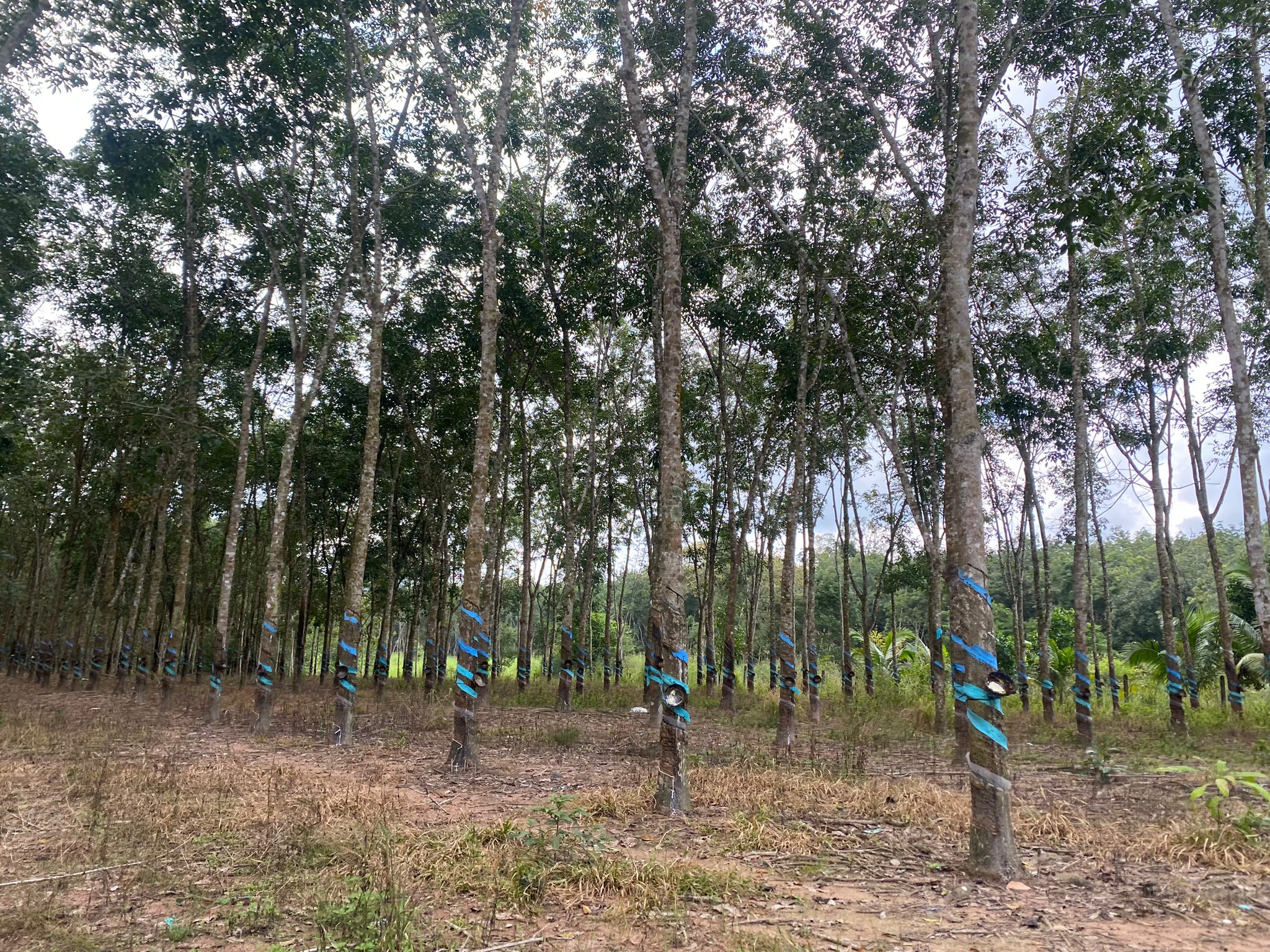
Rubber tapping in Tánh Linh is performed at night, starting around 2:00 a.m. This timing is crucial for maintaining latex flow:
-
Cooler temperatures during the night and early morning allow the latex to flow more easily and prevent it from drying too quickly.
-
Around 4:00–5:00 a.m., when the air is at its coolest and most humid, latex flow reaches its peak.
-
As the sun rises and temperatures increase, the latex begins to coagulate, reducing yield.
Each tree is tapped by making a thin, diagonal incision on the bark. The latex drips slowly into small collection cups for 4 to 5 hours. Later in the morning, farmers collect the latex before it hardens.
Tree Lifespan and Local Importance
Rubber trees typically begin to produce latex after about six to seven years and can be tapped for 25 to 30 years.
Working Conditions of Rubber Farmers
Rubber tapping is a demanding and repetitive job that requires precision and endurance. The plantations can be located far from the workers’ homes, and since tapping takes place in the middle of the night, farmers must adapt their daily routines around this schedule.
Most workers operate alone, guided only by a small headlamp, moving quietly from tree to tree in the dark. The work can be physically tiring and isolating.
Despite the challenges, rubber cultivation continues to be an essential part of the local economy and remains a vital source of income for many rural families in Tánh Linh.

Leticia